Web Design in 2026: Why Your Website Needs to Be an Experience, Not a Brochure
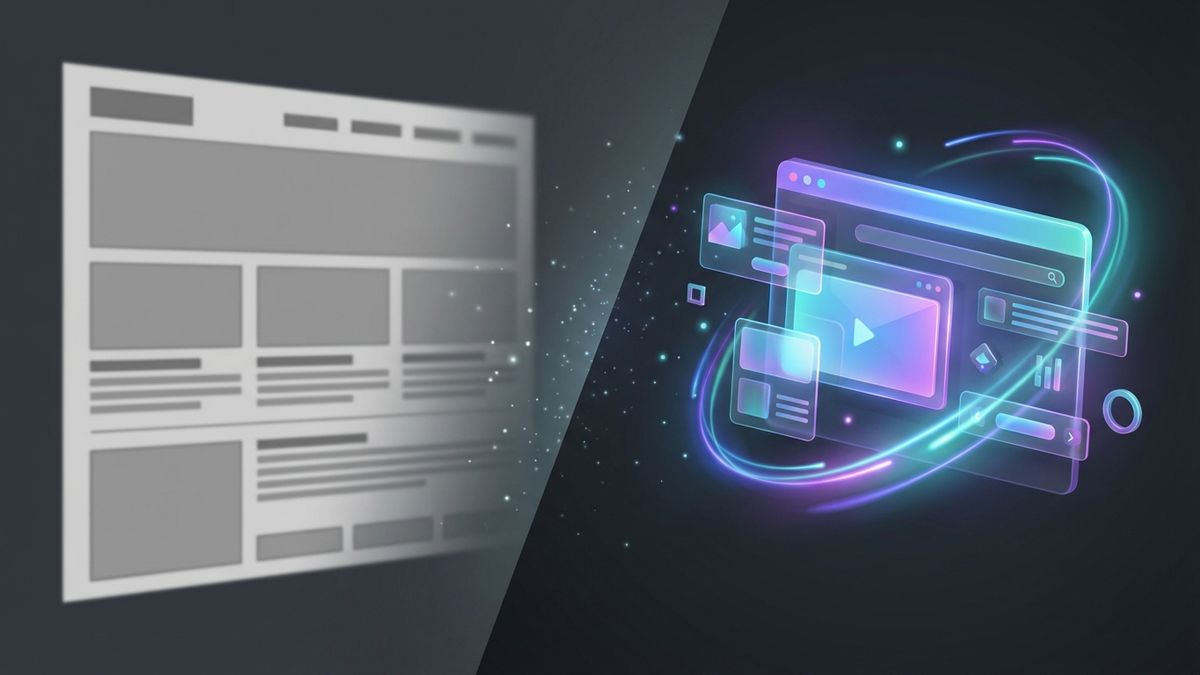
Something fundamental has changed about how people use the internet, and most businesses haven't caught up yet. The website you built two or three years ago — the one with carefully written service pages, a polished about section, and a blog optimized for search — may already be losing its relevance. Not because the design looks dated, but because the entire model of using a website as an information delivery tool is being undermined by artificial intelligence.
The Traffic Cliff No One Talks About
Here’s a number that should concern every business owner: over 58% of Google searches in the US now end without a single click to any website. People get the answer they need right there on the search results page — thanks to AI-generated summaries, featured snippets, and knowledge panels. For businesses that relied on organic traffic as a primary channel, this is not a trend. It’s a structural shift.
It gets worse. Google’s AI Overviews — those AI-written summaries that now appear above traditional search results — have been shown to reduce click-through rates by roughly 61%. If your website’s main purpose is to answer questions that AI can answer just as well, your traffic is going to keep shrinking. It’s not a matter of if, but how fast.
Information Is Now a Commodity
Think about what most corporate websites actually do. They describe services, list pricing, explain how things work, and publish thought leadership content. All of that is information — and information has become a commodity. AI tools like ChatGPT, Perplexity, and Google’s own Gemini can synthesize that information faster and more conveniently than any website.
This doesn’t mean websites are dying. It means the purpose of a website is changing. The sites that will thrive are the ones that offer something AI simply cannot replicate: a felt experience. Something visual, interactive, and emotionally resonant that makes you want to stay, explore, and share.
From SEO-First to Experience-First
For the past decade, most web strategies started with the same question: how do we rank higher on Google? Every design decision, content plan, and technical choice was filtered through the lens of search engine optimization. That approach worked brilliantly when Google was the gateway to the internet.
But when the gateway starts answering questions itself, you need a different strategy. The winning question in 2026 is not “how do we rank?” but “why would someone visit our site at all?” And the answer has to be: because the experience itself is worth visiting.
This means rethinking how you measure success, too. Instead of obsessing over organic search rankings alone, forward-thinking companies are tracking metrics like earned media value (how much social sharing would cost as paid ads), time spent on site, engagement depth, and what you might call “screenshot-worthiness” — whether your site is compelling enough that people share it on social media unprompted.
What Experience-First Actually Looks Like
Experience-first design is not about adding flashy animations to an otherwise standard site. It’s about making the website itself the product — something people engage with rather than scan through. Here’s what that looks like in practice:
Scroll-Driven Storytelling
Instead of laying out information in static sections, leading brands are building narratives that unfold as you scroll. Think of how Apple’s product pages work — the device rotates, features reveal themselves through animation, and the scroll itself becomes the interface. This approach transforms passive reading into active participation.
Meaningful Interactivity
Interactive content consistently delivers around twice the engagement of static content. But the key word is “meaningful.” Interactive elements should help people explore your product, understand your value proposition, or simply enjoy themselves. Configurators, interactive demos, data visualizations that respond to input — these give visitors a reason to stay that no AI summary can replace.
Rich Animation and 3D
The technology for delivering sophisticated visual experiences on the web has matured dramatically. Tools like Three.js and WebGPU are now production-ready across major browsers, making it feasible to build cinematic web experiences that would have been impractical just two years ago. The important distinction: animation should communicate, not decorate. Every motion should serve a purpose — guiding attention, explaining a concept, or creating an emotional response.
Where AI Actually Helps (And Where It Doesn’t)
The irony is that while AI is undermining traditional websites, it also offers some genuinely useful tools for building better ones. The trick is knowing where AI adds real value versus where it’s just a buzzword.
AI works well for personalized experiences — dynamically adjusting landing page content based on who’s visiting, or powering a conversational interface that helps people discover products through natural dialogue rather than browsing through category pages. These applications make the website smarter and more useful.
AI doesn’t work well as a generic chatbot bolted onto an existing site, as a replacement for genuinely useful content, or as a novelty feature added just so you can say “we use AI.” Visitors see through that immediately. If your AI feature doesn’t save someone time or give them something they couldn’t get elsewhere, skip it.
What You Should Do Next
If you’re a decision-maker wondering how this applies to your business, here’s a practical starting point:
Audit your current website. Go through every page and ask: could AI answer this question without anyone visiting my site? If the answer is yes for most of your content, you have a problem — and an opportunity.
Define experience goals before design goals. Before thinking about layouts and colors, ask what you want people to feel and do on your site. What’s the emotional takeaway? Where do they have agency? What would make them want to share it?
Start with one high-impact page. You don’t need to rebuild your entire site overnight. Pick your most important landing page or product page and transform that one into a genuine experience. Use it as a proof of concept to measure the impact on engagement, sharing, and conversion.
Don’t forget performance. A beautiful, interactive website that loads slowly is worse than a fast, simple one. Performance is non-negotiable. Over 60% of social-driven traffic arrives on mobile, so your experience needs to be fast and fluid on every device.
The Bottom Line
The age of the brochure website is ending. Not with a dramatic crash, but with a slow decline in traffic and relevance as AI absorbs the informational tasks that websites used to own. The businesses that adapt — by treating their websites as experiences worth visiting rather than documents worth reading — will find themselves with a powerful competitive advantage. In a world where information is free, experience is what people will pay attention to.
The question isn’t whether your industry will be affected. It’s whether you’ll be the one creating experiences or the one watching your traffic disappear into an AI-generated summary.